
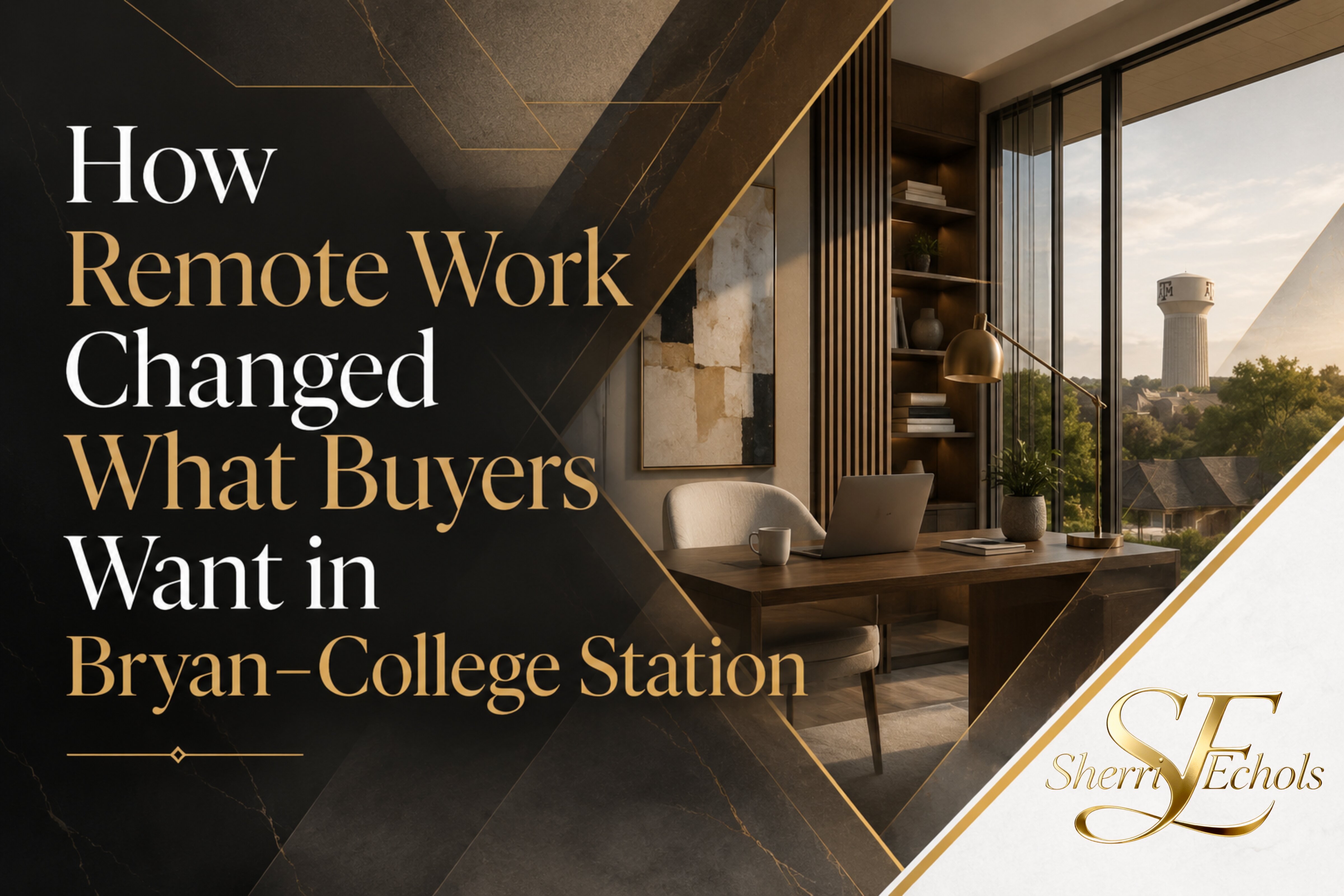
Remote work home buying in Bryan–College Station has changed the way buyers look at homes.
Before remote and hybrid work became so common, many buyers focused mostly on commute, bedroom count, square footage, schools, price, and neighborhood. Those things still matter. But now buyers are looking at homes through a different lens.
They are asking, “Where would I work?”
They are thinking about internet speed, quiet rooms, natural light, Zoom backgrounds, flexible spaces, noise, privacy, storage, outdoor breaks, and whether the home supports the way they actually live Monday through Friday — not just evenings and weekends.
That shift matters in Bryan TX, College Station TX, and across the Brazos Valley. Some buyers still need to be close to Texas A&M, hospitals, schools, RELLIS, local employers, or Highway 6. Others may work from home part of the week and care less about a five-minute commute than they used to. Some relocation buyers are choosing Bryan–College Station because they can keep a remote job while moving to a community with more space, a strong local identity, Texas A&M energy, and a different pace of life.
Quick answer: Remote work changed what buyers want in Bryan–College Station by increasing demand for home offices, flexible rooms, reliable internet, quiet spaces, better lighting, larger lots, outdoor areas, comfortable neighborhoods, and homes that support daily life instead of only after-work living.
Why Remote Work Home Buying in Bryan–College Station Matters
Remote work home buying in Bryan–College Station matters because buyers are using their homes differently now.
A home is no longer just where people come back after work. For many buyers, it is also the office, conference room, schoolwork zone, workout space, creative space, lunchroom, quiet retreat, and sometimes the place where two adults are both trying to work at the same time.
That changes what feels functional.
A beautiful home can still feel frustrating if there is nowhere quiet to take a call. A smaller home can feel surprisingly workable if it has a smart layout, good light, and a separate office nook. A larger home can still disappoint if every space echoes, the internet is weak, or the only possible office is in the middle of household traffic.
Buyers are not just asking, “Do I like this house?”
They are asking, “Can I live and work well here?”
Home Offices Are No Longer a Bonus for Many Buyers
A dedicated home office used to be a nice extra.
Now, for many buyers, it is a serious feature.
That does not always mean a formal study with French doors, although buyers love that when they can find it. It may mean a fourth bedroom, a flex room, a quiet loft, a dining room that can convert well, a built-in desk area, a bonus room, or even a well-positioned corner with natural light and privacy.
In Bryan–College Station, this matters for remote workers, hybrid professionals, Texas A&M faculty, graduate students, consultants, entrepreneurs, military spouses, veterans transitioning careers, and relocation buyers who need to work from home at least part of the week.
A home with a believable work space can feel more valuable than one with the same square footage but no clear office solution.
Buyers Want Flexible Rooms
Remote work has made flexible rooms more important.
Buyers want spaces that can change with life. A room may need to work as an office today, guest room next month, nursery later, workout room after that, or study space for teenagers in a few years.
That flexibility matters because life changes quickly.
A buyer may not need a full-time office forever, but they may still want options. Hybrid work schedules can change. Children grow. Aging parents visit. Adult children come home. Hobbies need space. Businesses start at kitchen tables and eventually need their own room.
Homes that offer flexibility often feel safer to buyers because they can adapt.
Quiet Has Become a Real Buyer Priority
Quiet matters more when home is also the workplace.
Buyers notice whether an office would be near the front door, kitchen, laundry room, garage, kids’ bedrooms, street noise, or living room. They think about barking dogs, traffic, yard crews, school pickup traffic, and whether the house has enough separation for real concentration.
In Bryan–College Station, this can influence neighborhood choice.
Some buyers want the energy of being close to Texas A&M, downtown Bryan, Northgate, or busy convenience areas. Others want a quieter street, a deeper lot, a cul-de-sac, more distance between homes, or a neighborhood where work calls will not feel interrupted all day.
Remote work made sound part of the buying decision.
Internet Reliability Matters More Than Ever
Reliable internet is now a home-buying issue.
Buyers who work remotely need to know whether they can handle video calls, file uploads, streaming, cloud software, online meetings, virtual teaching, digital marketing, real estate work, design work, telehealth, or remote client meetings from the home.
This is especially important for buyers looking outside central areas, in rural-edge properties, acreage, older neighborhoods, or areas where service options may vary.
Before buying, remote workers should verify internet providers, speeds, service reliability, installation options, and backup plans. Do not assume every property has the same connectivity just because it is in the Bryan–College Station area.
For sellers, internet access can be a real selling point when it is strong and reliable.
Zoom Backgrounds Are Funny — Until They Matter
It sounds silly, but buyers do think about where they would take a video call.
They want a background that looks professional, calm, and not chaotic. They notice natural light, wall space, noise, clutter, and whether the likely office area would feel presentable on camera.
For people who work with clients, students, teams, executives, patients, vendors, or employees, this matters.
A home office does not have to look fancy. It just needs to function well and feel professional enough for the buyer’s work life.
Sometimes a simple, quiet, well-lit room can carry more value than an oversized open area that has no privacy.
Natural Light Matters More During the Workday
When people leave home all day, they may not think as much about daytime light.
Remote workers do.
They notice whether the home feels bright during work hours. They notice glare, dark rooms, window placement, trees, covered patios, and whether the office space would feel pleasant after several hours.
A bright room can feel energizing. A dark room can feel draining.
In Bryan–College Station, where many homes have mature trees, covered patios, deep porches, or strong afternoon sun, buyers need to think about how each room feels during the day — not just during an evening showing.
Commute Still Matters, But Differently
Remote work did not eliminate commute concerns.
It changed them.
A buyer who goes into the office five days a week may prioritize commute heavily. A hybrid worker may be willing to live a little farther from work if the home offers more space, a better office, or a neighborhood they love. A fully remote worker may care more about internet, quiet, and lifestyle than daily drive time.
In Bryan–College Station, this can open up more neighborhoods.
A buyer who once insisted on being close to Texas A&M or central College Station may now consider Bryan, south College Station, west Bryan, acreage-style options, or neighborhoods with better space and comfort if they are not commuting every day.
Remote work changed the tradeoff.
Bryan Is Getting More Attention From Remote Workers
Remote and hybrid work have helped some buyers look more seriously at Bryan.
If a buyer does not need to be in a specific office every day, Bryan may offer a compelling value conversation. More space, established neighborhoods, downtown Bryan energy, mature trees, larger lots in some areas, and a different pace can be very attractive.
That does not mean Bryan is right for everyone.
But remote work gives buyers permission to think differently.
A buyer who once focused only on College Station may realize that a Bryan neighborhood gives them the office, yard, payment, and lifestyle they actually want.
College Station Still Has Strong Remote-Work Appeal
College Station still appeals strongly to remote and hybrid workers too.
Some buyers want to be close to Texas A&M, schools, parks, restaurants, medical care, shopping, fitness, and the energy of Aggieland. Others want established College Station neighborhoods, southside convenience, newer construction, or a community with strong name recognition.
Remote work does not make location irrelevant.
It makes lifestyle fit more important.
For some buyers, College Station offers the right mix of convenience, community, and daily-life support even if they are not commuting every day.
Relocation Buyers Are Thinking Differently
Remote work changed relocation.
Some buyers moving to Bryan–College Station are not moving because their job transferred them here. They are moving because they can work from anywhere and they want a different life.
They may want to be closer to family. They may be returning to Aggieland. They may want a smaller community than Houston, Austin, Dallas, or another major metro. They may want more space, a lower-stress pace, Texas A&M access, veteran community, or a place that feels more grounded.
That kind of buyer is not just shopping for a house.
They are shopping for a lifestyle.
Remote Workers Care About Neighborhood Feel During the Day
Neighborhoods feel different during the workday than they do in the evening or on weekends.
Remote workers may notice daytime noise, traffic, school activity, yard maintenance, construction, deliveries, pets, and whether the street feels peaceful while they are home working.
This is one reason buyers should visit neighborhoods at different times if possible.
A neighborhood that feels calm on a Sunday afternoon may feel different during school pickup or weekday construction. A street that feels busy at 5 p.m. may feel perfectly quiet during the workday.
Remote work makes daily rhythm more important.
Outdoor Space Became More Valuable
Remote workers often value outdoor space because they are home more.
A patio, porch, shaded backyard, garden space, walking trail, nearby park, or even a pleasant front porch can make the workday feel better. Buyers imagine stepping outside between calls, walking the dog at lunch, drinking coffee before a meeting, or getting fresh air without leaving the neighborhood.
In Bryan–College Station, outdoor space can be a meaningful lifestyle feature.
Some buyers want low-maintenance patios. Others want yards, trees, gardens, or room for pets and kids. Some want proximity to parks and trails. Others want enough land or space to breathe.
Remote work made those choices feel more important.
Floor Plan Matters More Than Square Footage Alone
Remote work made layout more important than raw square footage.
A 2,100-square-foot home with a quiet office may work better than a 2,500-square-foot home where every space is open and noisy. A smaller home with a split-bedroom plan may feel more functional than a larger home with no private work area.
Buyers are thinking about how sound moves, where desks can go, whether doors close, whether two people can work at once, and whether the home supports real life.
That is why sellers should not market only square footage.
They should explain function.
Open Concept Is Not Always Enough Anymore
Open-concept living is still popular, but remote work exposed its limits.
Open spaces are great for gathering, entertaining, and keeping family connected. But they are not always great for Zoom calls, focused work, virtual school, or confidential conversations.
Some buyers still love wide-open layouts.
Others now want a balance: open living areas plus private rooms, office nooks, bonus spaces, or flexible bedrooms.
The best floor plans give buyers connection and separation.
Storage Became More Important
Working from home often brings more stuff into the house.
Desks, monitors, printers, files, office supplies, books, equipment, cords, chargers, ring lights, microphones, samples, workout equipment, school supplies, hobby materials, and shipping boxes all need a place to go.
Buyers notice closets, built-ins, garages, laundry storage, pantry space, attic access, and flex-room storage more than they used to.
A home that can contain both work and life feels easier to manage.
Clutter is stressful. Storage creates breathing room.
Remote Work Made Coffee Shops and Third Places More Appealing
Remote workers do not always want to work from home every minute.
They may want nearby coffee shops, coworking spots, libraries, restaurants, parks, or places where they can get out of the house for a change of scenery.
In Bryan–College Station, this makes neighborhood context more important.
Some buyers may value access to downtown Bryan, Northgate, Texas A&M areas, south College Station, local coffee shops, or other places where they can work, meet, or reset during the day.
The home matters, but so does the life around it.
Remote Work Changed What “Convenient” Means
Convenience used to mean being close to the office.
Now it may mean being close to groceries, coffee, school, childcare, parks, medical care, gyms, restaurants, or places to walk during lunch.
For remote workers, the neighborhood becomes part of the workday.
A buyer may care less about shaving ten minutes off a commute and more about having a peaceful street, a good office, strong internet, and a place nearby to take a break.
That is a different kind of convenience.
First-Time Buyers Want Workable Spaces
First-time buyers may not be able to afford a large home with a dedicated office.
But they still want workable spaces.
They may look for a secondary bedroom, dining area, loft, nook, or corner that can serve as a desk area. They may care about internet, storage, lighting, and whether the home feels manageable for both work and life.
For first-time buyers, the question is often not, “Does this home have everything?”
The question is, “Can I make this work without feeling overwhelmed?”
VA Buyers May Value Stability, Space, and Quiet
VA buyers may also be affected by remote work trends.
Some veterans are transitioning careers, working remotely, starting businesses, going to school, or seeking a more stable home environment. They may want a quiet office, space for family, a manageable payment, a yard, and a home that supports long-term quality of life.
The VA loan can help eligible buyers purchase with little or no down payment, but the home still needs to fit the buyer’s daily life.
For remote-working veterans, layout, internet, neighborhood feel, and privacy can matter just as much as price.
Luxury Buyers Want Better Lifestyle Integration
Luxury buyers working remotely often want more than a basic office.
They may want a private study, separate work zones for two adults, strong internet infrastructure, quiet bedrooms, fitness space, outdoor living, a pool, privacy, acreage, views, or room to host family without disrupting work.
In higher-end Bryan–College Station neighborhoods like Pebble Creek, Miramont, Traditions, Indian Lakes, Mission Ranch, and Millican Reserve, remote work can make lifestyle features even more valuable.
Luxury buyers are not just asking whether the home is beautiful.
They are asking whether it supports the way they want to live every day.
Sellers Should Highlight Remote-Work Features
If a home has remote-work advantages, sellers should not hide them.
A private office, flex room, strong internet, built-ins, natural light, quiet street, split-bedroom floor plan, bonus room, backyard retreat, nearby coffee shops, or walking trails can all matter to today’s buyers.
Listing descriptions should help buyers understand how the home functions.
Instead of simply saying “four bedrooms,” explain that the fourth bedroom could serve as a quiet home office, guest room, nursery, or study. Instead of saying “large backyard,” help buyers picture lunch outside, pets playing, gardening, or a quiet reset between calls.
Function sells when buyers understand it.
Sellers Should Be Honest About Internet and Workability
Remote-work buyers will ask practical questions.
What internet providers are available? What speeds are currently used? Is there a dedicated office? Where would a second person work? Is the neighborhood quiet during the day? Does the house echo? Is there enough storage for office equipment?
Sellers should be ready with accurate information when possible.
Do not exaggerate internet capability or pretend a tiny hallway desk is a full office if it is not. Buyers appreciate clarity, and disappointment during a showing can hurt trust.
Buyers Should Test the Home Like They Actually Live
Remote-work buyers should tour homes with their real workday in mind.
Where would the desk go? Is there enough light? Can a door close? What is behind you on camera? Where would the printer go? Can two people work at once? Is the internet strong enough? Is the room too close to the kitchen, laundry, garage, or kids’ rooms?
Buyers should also think about neighborhood rhythm.
Is the street quiet enough? Are there places nearby to walk? Is there a coffee shop or library nearby if you need a change of scenery? Does the home support both productivity and rest?
Where Buyers Get This Wrong
Buyers get this wrong when they treat the office as an afterthought.
They fall in love with the kitchen, backyard, or neighborhood, then realize later that working from the dining table every day is miserable.
They may underestimate noise, lighting, storage, internet, or the need for separation.
If remote or hybrid work is part of your life, the home needs to support it from the beginning.
Where Sellers Get This Wrong
Sellers get this wrong when they fail to show buyers how the home could work.
A room used for storage may actually be a great office. A formal dining room may make a beautiful work space. A loft may be perfect for homework or a second desk. A guest room may be the flex space a buyer needs.
If the listing does not explain the possibility, buyers may not see it.
Staging and marketing should make flexible spaces obvious.
Remote Work and Resale Value
Remote work also affects resale thinking.
Even buyers who do not work from home full-time may recognize that future buyers will value flexibility. A home with a dedicated office, useful flex space, strong internet, and a functional layout may appeal to a wider buyer pool later.
That does not mean buyers should overpay just because a home has an office.
But it does mean work-from-home features can support long-term marketability when paired with good location, condition, pricing, and overall layout.
How Local Strategy Helps
Remote work has made local strategy more important, not less.
Buyers need help comparing Bryan vs. College Station, established neighborhoods vs. new construction, quiet streets vs. convenience, and space vs. commute. Sellers need help identifying which features matter to today’s buyer and how to market them clearly.
When I help buyers in Bryan–College Station, I want them to think about the home as a daily-life tool, not just a pretty set of photos.
When I help sellers, I want the marketing to show how the home supports the way people actually live now.
Bottom Line
Remote work changed what buyers want in Bryan–College Station because homes now have to do more.
Buyers care about home offices, flexible rooms, reliable internet, quiet spaces, natural light, storage, outdoor areas, neighborhood comfort, and whether the home supports both work and life.
In Bryan TX, College Station TX, and across the Brazos Valley, remote and hybrid work have also changed how buyers think about location. Commute still matters, but so do space, function, lifestyle, and daily comfort.
If you are buying, do not just ask whether you like the home. Ask whether it supports your real routine.
If you are selling, do not just list the rooms. Show buyers how the home works for the way people live now.
That is where smart real estate strategy meets real life.
Related Searches
The Best Coffee Shops for Remote Work in BCS
The Neighborhood Features Buyers Care About Most in 2026
Why Some Buyers Are Choosing Bryan Over College Station
What Out-of-Town Buyers Need to Know Before Buying in BCS
How Walkability and Convenience Affect Home Values in College Station
Written by Sherri Echols, Real Estate Broker in Bryan–College Station, Texas
Broker Associate, eXp Realty
Call or text: 979-492-0101
